

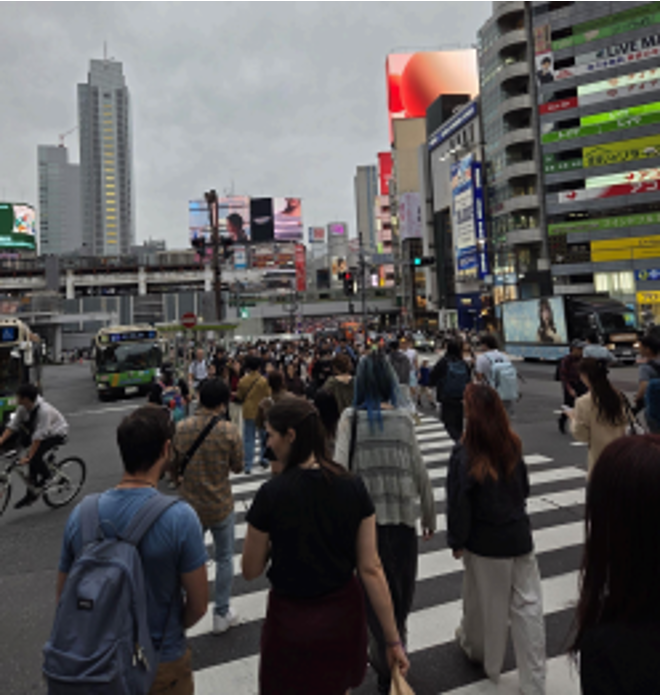
Walking amongst a messy crowd of people is a routine that comes naturally with living in a city. Bodies gather in physical space as our minds process information from our surroundings. Eyes meet through rainfall, and long jackets brush shoulder to shoulder. In Tokyo, thousands of people amass into crowds to form and fill popular neighbourhoods such as Shibuya and Harajuku (Figure 1), thus creating a kind of “imagined community” (Cook 98; Stanley). The intuitive memory accessed when crossing the street is collective, established through the repetition and mimicking of social behaviours that are learned, practised, and transmitted through lived experience. Drawing on Guy Debord’s notion of spectacle and theatre scholar Rebecca Schneider’s concept of “the remains” (Schneider 27), this paper proposes the body as an archive: a living, postcustodial site in which memory, gesture, and repetition are stored and communicated through everyday movements in public space (Cunningham; Cook).
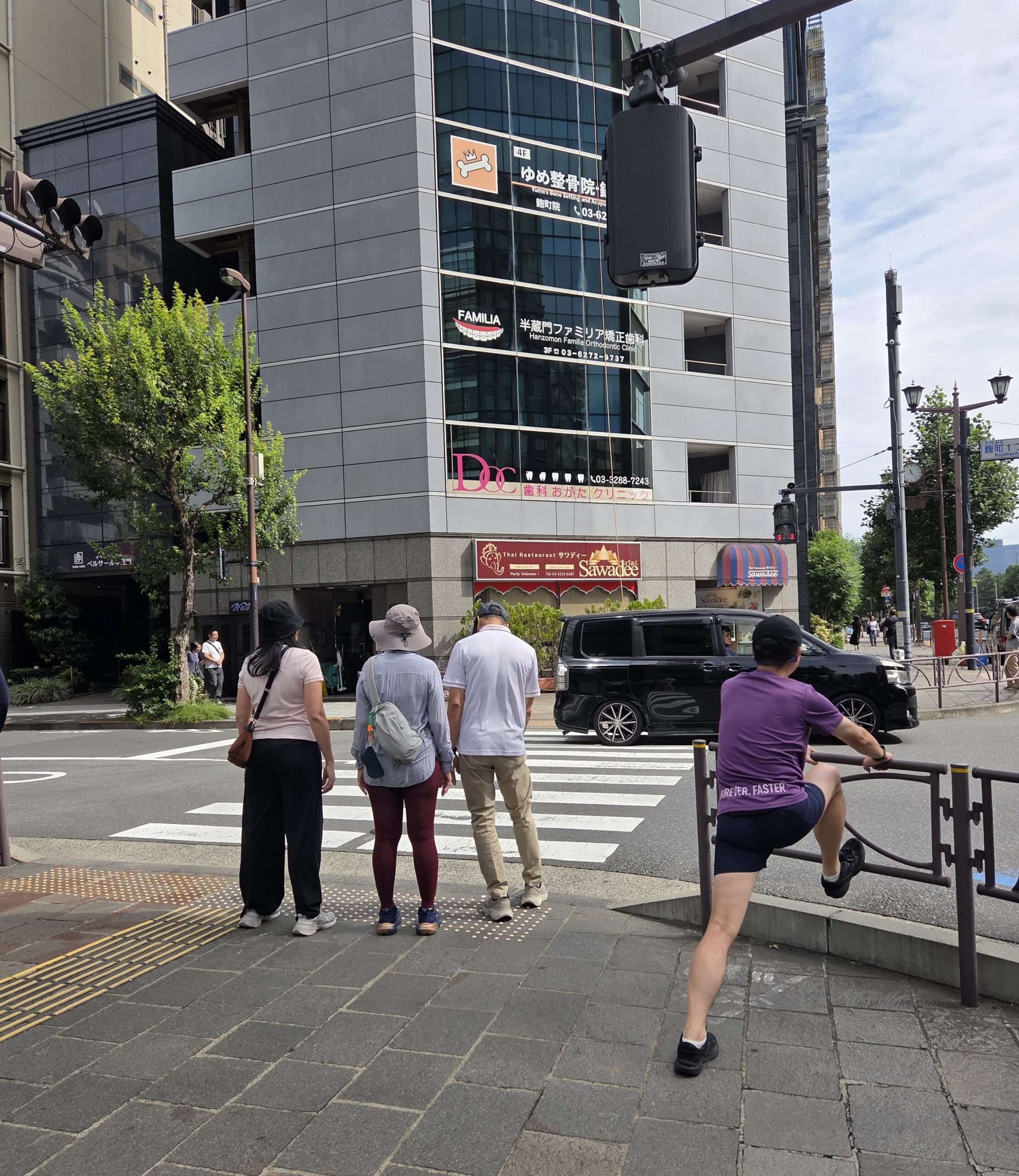
In the field of archival work, we are operating under increasingly postcustodial terms. Conversations about acknowledging positions of power while using professional skills to advise and assist in the maintenance of records have become more commonplace in archival scholarship and practice. In contrast to more traditional notions of record keeping, which often privilege preservation and stasis, postcustodial approaches prioritize access, truth, and the subjective ways information may be interpreted in order to establish more accurate depictions of passing time. The body as an archive extends this framework by emphasizing embodied forms of record-making, positioning archives as repositories of physical motion, oral storytelling, and emotion. A strong example of this can be found in what Rebecca Schneider terms “the remains” (Schneider 27). Crossing the street becomes a reenactment of a brief gesture such as a stretch or moment of rest that is both ephemeral and timeless (figure 2). We store, record, and learn from this action in ways comparable to how we learn from instruction manuals. The passing action leaves something behind for others to witness or take away from, reinforcing the gathering act as meaningful and preservable. What remains, then, is our existence within the intersection: the lived experience of routine and the ongoing relationships our bodies manifest, build, and recreate.
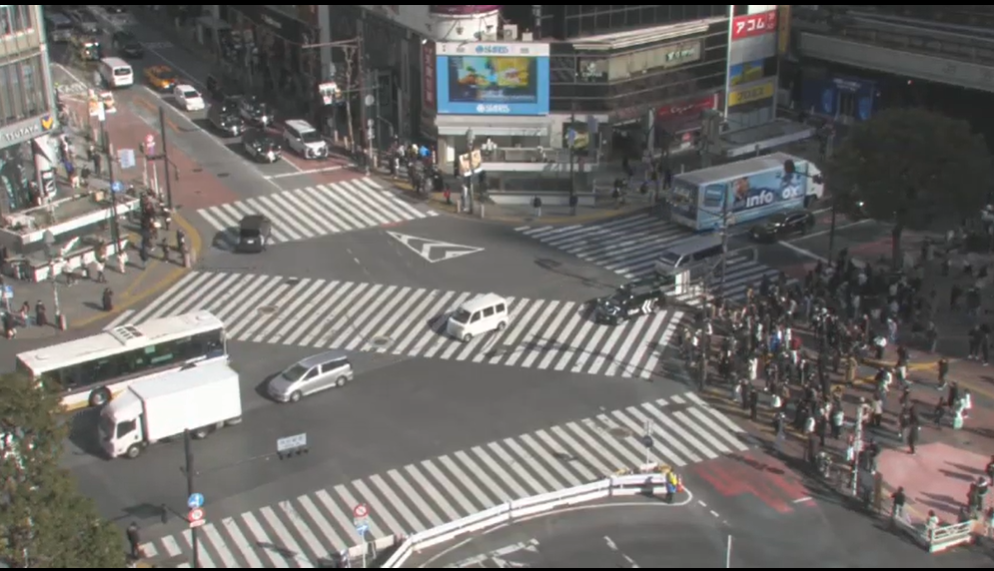
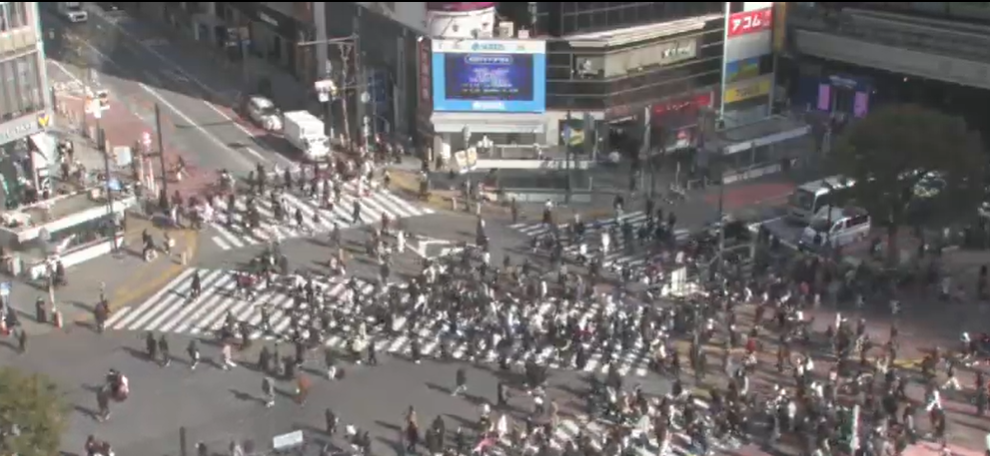
In The Society of the Spectacle (1967), Guy Debord argues that social relations have become mediated through representations such as images, resulting in social structures that are materialized, objectified, and unified. In Tokyo’s Shibuya neighbourhood, bodies move in herds through crosswalks and temporary tunnels walled by scaffolding, often passing through spaces they have already mentally departed. Shibuya Scramble Crossing is one of Tokyo’s most popular attractions and continues to entice tourists who visit the intersection simply to cross it (Figures 3 and 4). This act of performing a routine action offers insight into how bodily movement can be traced and preserved as an indicator of shifting temporal and social conditions.
this act of crossing the Scramble
As I participated in this act of crossing the Scramble, I retained the memory of what I witnessed. People stood in eager anticipation, and excitement rushed the streets once the light turned green. A man crossing the intersection while doing pirouettes and FaceTiming his girlfriend was captured and remembered by witnesses like me, yet I have no authority to manipulate that memory or his action within my own body. His gestures remain alive in my mind, contributing to the collective event of the crossing and creating a shared experience. If our bodies can create, manifest, and preserve memory in ways analogous to an archive, an important question emerges: who is the record keeper of the body in public space? A postcustodial approach suggests that archival authority may be dispersed rather than centralized, allowing the remains to become active and ever-evolving records of our existence and of our encounters with one another (Cunningham; Moreland). The imagined community formed through this crossing relies on moments of shock and wonder, transforming an otherwise familiar and routine task into something playful and memorable. Our actions within this space are recorded by one another as well as by the material beneath us, as the painted pavement gradually decays. Yet these are not the only ways in which bodies are archived. In an era of increasing surveillance, the city once again becomes a spectacle, framing pedestrians as performers. CCTV cameras record bodies and their movements, reproducing another layer of archival inscription. Here, bodies become imprints on space once more—this time in the digital realm, in the form of footage and electronic records.
Exploring a foreign city remains one of my most cherished pastimes
Even with the awareness of being watched, or the nerves that accompany being a woman alone at night, there is a heightened intensity that comes when facing another person at a crosswalk. Our passing figures may not interact, and our eyes may dodge one another, yet our presence is registered by the space and a tacit mutual acknowledgement. In that moment, my memory is engaged, performing a routine task and preserving that iteration which will again become a memory. For the body to be understood as an archive, we must be willing to challenge rigid definitions of records and to explore intangible forms of collective memory and embodiment. Memory-making and preservation involve complex and often delicate processes that may be traumatic or unstable, yet they remain essential. It is the responsibility of archivists to question what counts as a record and to develop more meaningful, dynamic, and inclusive ways of allocating information and sharing history.
WORKS CITED
Cook, Terry. “Evidence, Memory, Identity, and Community: Four Shifting Archival Paradigms.” Archival Science, vol. 13, nos. 2–3, June 2013, pp. 95–120. https://doi.org/10.1007/s10502-012-9180-7.
Cunningham, Adrian. “The Postcustodial Archive.” The Future of Archives and Recordkeeping: A Reader. Ed. Jennie Hill. Facet, 2010, pp. 177–194. Print.
Debord, Guy. The Society of the Spectacle. Translated by Donald Nicholson-Smith, Zone Books, 1995.
“Japan.” Tokyo: Shibuya Crossing Live Webcam – Japan – World Cams, worldcams.tv/japan/tokyo/shibuya-crossing. Accessed 22 Jan. 2026.
Moreland, Kelly A. “Toward a Rhetoric of Body as Space.” Peitho, vol. 21, no. 2, Spring/Summer 2019, pp. 404–425, http://peitho.cwshrc.org/files/2019/03/Moreland_Rhetoric-of-Body-as-Space-2.pdf.
Schneider, Rebecca. Performing Remains: Art and War in Times of Theatrical Reenactment.
Routledge, 2011. Print.
Stanley, Manfred. “The Rhetoric of the Commons: Forum Discourse in Politics and Society.” Teachers College Record: The Voice of Scholarship in Education, vol. 90, no. 1, Oct. 1988, pp. 1–17. https://doi.org/10.1177/016146818809000106.